Thursday, November 25, 2010

Interview with D - A Korean's take on Western food


For those of you who have been following my blog, you may have noticed that I have mentioned a mysterious “D” in some of my previous posts. D is a young Korean woman who I have had the pleasure of getting to know over the past year. She has given me huge insight into Korea’s inner workings, (food, teaching, love/sex, plastic surgery…you name it!), and we have become good friends in the meantime!

Here is an interview with her about her view on Western food from the time she spent at University in the United States. I hope you find it as smart and insightful as I did!

Q: How long were you in the United States, and where exactly did you live?

I was in the U.S. for about 2 years, and I lived in Greensboro, North Carolina. It was a really small city.

Q: What did you think of food in the U.S.?

At first, it was just great. Everything was very delicious. I enjoyed it for a while but later it made me fat, and I started to think it was too oily. In Korea, my ordinary meal was just rice with some side dishes, but in the States I had to eat out every time because I was in a dormitory, and every meal was too huge and heavy. I never ate everything at a restaurant. I gained too much weight and so fast, about 8 kilograms.

Q: What was the most surprising thing about American food?

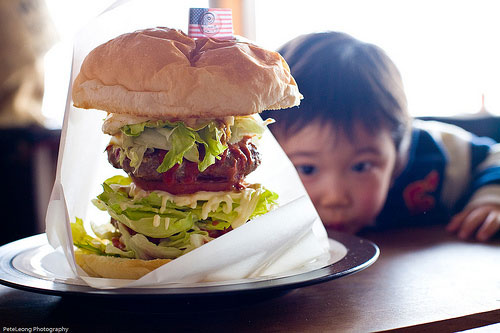
The biggest difference was that the average number of calories in the food was much higher than Korean food. People enjoyed appetizers and desserts. In Korea I eat the meal, mostly vegetables, and usually do not have dessert. The average size of a dish was much bigger than that in Korea.

It is the same with desserts. A cup of ice cream was huge. When I first went to Coldstone, I was surprised that the smallest size of a cup was still too big. It was good the first time, but l started to think like, "Why do people eat that much for no reason?” And for the size of a cup of coffee, the largest size in Korea was “grande”, not “venti”. For me, everything was too much and too big.

Q: What were some other differences between American and Korean food that you noticed?


We do not usually order any drinks in Korea when we eat out. I was surprised that most people had soda or sweet tea during their meal. I think that was one of the reasons that I gained weight.

Also they ate too many fried things. People who control their diet still eat healthily even in the States, but most people eat too much oily food.

One more thing - people in the States eat too much meat. We eat meat sometimes in Korea, but not everyday. I don't think eating meat everyday is a way to be healthy.

Q: Did you eat more American food or Korean food while you were in the U.S.?


I couldn't eat the same as Americans. I was worried that if I kept eating like them, I would suffer from obesity. My body couldn't stand the food that I ate everyday. So I ate subs or salad, or went to Asian restaurants, but the dishes were still huge.

Sometimes I ate Korean food at the only Korean restaurant when I felt sick of eating Western food, but not very often. It was too expensive, because I would compare the price in Korea with the price there.

Q: How about the way of eating, like not sharing your food with other people (something that is common in Korea)? Was that surprising?

It was not that surprising. Since a dish is very big, it could be a good idea for two people to share it, but I knew it was a cultural thing, so I wasn't surprised. In Korea, we do not share food that much like before, especially younger people don't do it that much. But still, we sometimes order food and eat it together - it happens between close friends. Sharing has to be natural in Korea, because we have a lot of foods like big stews that we boil on the table during a meal. I think it's just a cultural difference.

Q: How often do you eat Western food now that you’re back in Korea? What kind of food do you eat?

I'm on a diet now, so I try not to eat Western food except like salad. But before I ate it maybe more than once in a week. They're not original, but I can find Western restaurants everywhere. I liked cheeseburgers and subs. Since the taste of Western food is not the same as what I had there, I sometimes cook for myself things like chicken noodle soup or macaroni and cheese.

I miss cheap hotdogs, buffalo wings, chicken noodle soup at the school cafeteria, burgers at Wendy's (there's no Wendy's in Korea), Chick Fil-a...mostly I can't taste them here.

Q: Anything else to add about your experiences with food in the U.S.?

I think the food in the States is very delicious and I'd like to enjoy it, but it's hard to find healthy options. I prefer Korean food for my everyday meal. It’s just too oily to eat everyday.

Before I went to the States, I couldn't understand the reason why my Western friends said Korean food is very healthy, but I can understand now.

Thank you D! <3

Sunday, November 21, 2010

Rice and diabetes

A follow-up to the blog I wrote about white rice and its link to type 2 diabetes ("Like white on rice")...

This was a study published recently in the Korean Diabetes Journal, where overweight and obese Korean women with type 2 diabetes were given smaller rice bowls than the standard (able to hold around 200 kcal of rice), in an effort to curb carbohydrate intake. Body weight decreased in both the overweight and obese groups, and macronutrient balance was obtained. However, it must be noted that the sample size was relatively small and the study period was short, so further research is needed.

Click here for the full article:

The Effects of Small Sized Rice Bowl on Carbohydrate Intake and Dietary Patterns in Women with Type 2 Diabetes

Another study comparing the small rice bowl diet plan to the conventional meal exchange program in type 2 diabetic women showed that the small rice bowl meal plan was as effective as the meal exchange plan in terms of reduction in body weight and increase in glucose control.

Click here for the full article:

Small Rice Bowl-Based Meal Plan versus Food Exchange-Based Meal Plan for Weight, Glucose and Lipid Control in Obese Type 2 Diabetic Patients

Monday, November 15, 2010

South Korea's luxury cattle a source of national pride

An article from CNN on South Korea's cherished Hanwoo beef.

Watch the video for footage of the massive riots following the lift on U.S. imported beef...I was very surprised at how strongly Koreans feel about the issue!

http://edition.cnn.com/2010/WORLD/asiapcf/11/05/southkorea.ilist.beef/index.html

"I have a wife and kids, but these cows are almost the same to me," says farmer Park Young Kil.


Kimchi crisis leaves South Koreans in a pickle

Here's an interesting article, from a month or so ago, about the kimchi crisis in South Korea! Who knew?!

http://www.npr.org/templates/story/story.php?storyId=130371965


It really gives you a sense of just how important kimchi is to a traditional Korean diet...

"I don't know how long I can keep ignoring my grandkids' and my husband's demands for kimchi every meal," said Kim Hyung-sook, who lives in northern Seoul. "You're not Korean if you don't eat kimchi three times a day."


Saturday, October 30, 2010

Nutrition transition in South Korea: a unique case

Last semester, when going through a newspaper article about foreign foods with one of my more advanced classes, I was surprised to find out that most of the students had not tried any of the foreign food discussed in the paper, even with some foods coming from places as close to Korea as China or Japan. This was shocking to me; I wouldn’t say Seoul, one of the biggest cities in the world, is lacking in the foreign food department. In the areas with a high concentration of foreigners, there is a wide variety of international cuisine, and even in the more “Korean” neighbourhoods, you can’t walk a block without passing a “Dunkin’ Donuts”, a “Paris Baguette”, and a “Pizza School” (not exactly international cuisine, but definitely indicative of Western influence). Yet, despite this international presence, most of the students seem to stick to a pretty traditional Korean diet for the majority of their meals, cooked by their traditional Korean stay-at-home moms.

When I asked a student how often he ate Western food, he told me that it is rare for him or his family to eat it. It is only on special occasions that they might have a Western meal at Outback Steakhouse or one of the other foreign restaurant chains, something I found slightly surprising considering the number of Western-style restaurants in Seoul.

This led me to wonder…

How does South Korea manage to maintain such a traditional diet in an increasingly globalized world?

And this, in turn, led me to the concept of nutrition transition.

Nutrition transition definition

A nutrition transition is something that happens in middle and lower-income countries as they develop and become more industrialized. Cities grow and begin to offer imported foods from industrialized countries. Unfortunately many of these foods are heavily refined, high in added sugar and saturated fat and low in fiber (1). In other words, it is a shift to, essentially, the “Western diet”, resulting in malnutrition from a lack of high-quality nourishment as well as obesity.

This used to only happen in developed countries, but now it is taking place in developing countries as well. Malnutrition that was once signaled by emaciated bodies is now affiliated with obesity. The change in diet is accompanied by a shift in disease patterns from communicable diseases to chronic diseases (2). All in all, a transition from a traditional diet to a Western diet is never a good thing.

Traditional diet → Western diet = malnutrition + obesity + chronic disease

Although, South Korea modernized a lot earlier than most other Asian countries, its nutrition transition patterns stand out from the rest of Asia. After recovery from the Korean War (1950-1953), South Korea’s economy grew rapidly, and with this growth came the introduction of components from the Western diet, such as fast-food restaurants, which became popular with the younger generation (3).


The studies I looked at examined changes in diet, obesity and overweight, as well as disease and mortality that reflect the nutrition transition in South Korea. I will outline the major trends below. It should be noted, however, that the data was taken from 1995 and 1998 Korean National Health Surveys. Unfortunately, in some areas, I couldn’t find anything more recent because the statistics are in Korean, but I have supplemented the findings of the older studies with recent data where available.

Diet: high in vegetables, low in fat

The studies I looked at highlighted a large increase in animal food products, (meat in particular), and a decrease in cereal intake, (principally rice), in South Korea during the nutrition transition. Rice remained the most consumed food, followed by kimchi (see “Oh holy kimchi” for more info!) (3).

Plant foods, including fruits and vegetables, are central in a Korean diet, with a daily vegetable intake of 280 grams per capita, which is among the highest in Asia (4). Recent surveys show that this large vegetable intake has increased even further in recent years to almost 336 grams per day in 2005, which is remarkable considering this rise is the opposite of what is normally seen in a nutrition transition (5).

The other most notable trend is concerning fat intake. The daily per capita fat intake has more than doubled from 16.9 grams in 1969 to 41.5 grams in 1998. Although this represents a considerable increase, the proportion of energy that Koreans get from fat is still significantly lower than other Asian countries (3).

Currently, contribution of fat to total energy remains below 20% as is recommended by Korean nutritionists (6). One theory regarding the low fat intake is that it can be linked to Korea’s high carbohydrate consumption, which makes up a large portion of total energy intake. Carbohydrate intake has not declined rapidly in South Korea as it has in other developing nations. Another theory relates to Koreans’ method of cooking which involves using only small amounts of sesame-seed oil (7).

Obesity/overweight rates: low but problematic

Rates of obesity are markedly low in South Korea, but rates of overweight are quite a bit higher. In 1998, rates of obesity in adults were 1.7% for men and 3.0% for women (3), and ten years later, in 2008, data indicated that 4.0% of Korean men were obese versus 3.6% of Korean women (8). Rates of overweight in 1998 were 24.3% for men and 23.5% for women (3). Data from 2001, just three years later, shows overweight statistics of 29.6% in adult men and 25.9% in adult women (this is the most recent data I could find) (9).

Although rates of both obesity and overweight have increased, prevalence of obesity in South Korea is much lower than in Western countries, and also lower than that of other Asian countries as well (3). Overweight is a bit more of a problem, however (more to come on this…).

Disease and mortality: a late transition

Disease patterns in South Korea have shifted from communicable diseases to non-communicable diseases, as is the norm in a nutrition transition, but this shift occurred in the 1970s, compared to the 1940s in the United States and 1950s in Japan. The rate of death from infectious and parasitic diseases (per 100,000 people) decreased from 23.2 people in 1985 to 11.7 people in 1999 (3).

Today, Koreans continue to maintain a relatively low level of non-communicable diseases compared to other countries of similar economic development (6).

“Sin-To-Bul-Yi: A body and a land are not two different things”


“Sin-To-Bul-Yi” is a concept promoted in South Korea that means a person should eat foods produced in the land in which he or she was born and is living. This is just one of many movements to retain the traditional diet in Korea. These methods range from TV programs promoting local food to the government putting on workshops to train the public in traditional cooking methods (7). The Korean Dietetic Association (KDA) also plays a large role in publicity and education. They provide nutrition services, hold seminars, monitor food and nutrition information in the media, and distribute educational materials, among other things (3).

Despite the internationalization that has occurred in South Korea, fat intakes have not increased to the extent that they have in other countries, nor have obesity rates, thanks, in part, to huge efforts on the part of the Korean government and other associations. This case is an exception to the usual cases of nutrition transition that have occurred around the globe.

It would be valuable for other Asian countries, (and any country, really), to examine South Korea’s tactics in the hope that they too can prevent the remnants of their traditional diet from slipping away, at the inestimable expense of their health.

Sources

(1) Popkin B. 2010. What is the nutrition transition? http://www.cpc.unc.edu/projects/nutrans/whatis. Access date: October 5, 2010.
(2) Wikimedia Foundation Inc. 2010. Nutrition transition. http://en.wikipedia.org/wiki/Nutrition_Transition. Access date: October 5, 2010.
(3) Lee MJ, Popkin BM and Kim S. 2002. The unique aspects of the nutrition transition in South Korea: the retention of healthful elements in their traditional diet. Public Health Nutrition 5(1A): 197-203.
(4) Kim SW and Popkin BM. 2000. Reply to salt consumption during the nutrition transition in South Korea [letters to the editor]. Am J Clin Nutr 72: 199-201.
(5) Lee JS and Kim J. 2010. Vegetable intake in Korea: data from the Korean National Health and Nutrition Examination Survey 1998, 2001 and 2005. Br J Nutr 103 (10): 499-506.
(6) Kim CI. 2010. The Korean Experience: Dietary Transition. www.who.or.jp/AHP/docs/200409/abstract3.pdf. Access date: October 27, 2010.
(7) Kim SW, Moon SJ and Popkin BM. 2000. The nutrition transition in South Korea. Am J Clin Nutr 71: 44-53.
(8) Organisation for Economic Cooperation and Development. 2010. OECD Health Data 2010. http://stats.oecd.org/Index.aspx?DatasetCode=HEALTH. Access date: October 27, 2010.
(9) Cho SJ, Ministry of Health and Welfare. 2002. Nutrition Overview – Republic of Korea. www.wpro.who.int/internet/resources.ashx/NUT/kor.pd. Access date: October 27, 2010.

Thursday, September 23, 2010

The skinny on eating disorders in Korea

South Korea is a country of tiny women and sometimes, even tinier men. The sight of anyone significantly overweight causes me to do a double take in the subway, and more often than not, it turns out to be a foreigner.

It’s a land of the “free size”, the one and only size available in most Korean-made clothing and probably for good reason: one size does generally fit all. I always thought that Koreans were just naturally small-framed, and to a large extent this is true; genetics combined with a (fairly) healthy lifestyle play a huge role, but what I didn’t realize is that the rates of eating disorders are high…and on the rise.

I guess I really shouldn’t be surprised, considering the tremendous value put on appearance here. Everywhere you turn, there’s a Korean looking in the mirror, glass (anything reflective!) at themselves; examining every bump and imperfection, adjusting their hair, make up, sometimes just unabashedly staring (and in the worst cases, popping their pimples…or even their boyfriends!). In Canada, I would be embarrassed to be caught catching a glimpse of myself while passing a mirror or taking a sultry self-portrait, but here, it’s entirely commonplace.

I’m not saying that appearance isn’t important; some Canadians could certainly take a little more pride in theirs (pajama pants in public…come on!), but when you have to send a photograph in with your resume to apply for a job, it’s not hard to see why Koreans might get hung up on their looks…and their weight.

Mirror, mirror on the wall…

As a result, plastic surgery is popular and widely accepted in Korea. I went with my Korean friend, (we’ll call her D), to get my hair done one Saturday afternoon, and was bombarded with advertisements for plastic surgery of all types as I flipped through a Korean magazine. When D started naming off all the different kinds of surgery that the Korean teachers at our academy had had done, I was exceptionally taken aback: double eyelid surgery, nose jobs, fat from the thigh injected into the forehead and cheeks (to make the face less flat), and even into the back of the head (to make the head rounder)!

Double eyelid surgery seems to be the big seller around here. If you’re wondering what the heck “double eyelids” are, they are the eyelids that non-Asian people have, i.e. not hooded eyelids (see the picture on the left). These surgeries are increasingly common: they’re often given as graduation gifts to girls from their parents after they finish high school.

The before and after pictures in the magazines suggested an interesting, if not disturbing, trend. To me, the before pictures looked very Korean, while the after pictures looked much more Caucasian, as if the person was only half Korean (see picture below). D told me that many Asian models and actresses who we in the West think of as being very beautiful, are seen in Korea as ugly, because they tend to have very “Asian” features, like sharp, defined cheekbones, small noses, and distinct almond-shaped eyes. I myself wouldn’t mind a nice delicate Asian nose, mine being a little above average in size, (maybe a slight understatement), but in Korea, I am often praised for having such a “high” nose, a term I much prefer to the usual ones I hear back home (usually more along the lines of “beakish”), although one little boy did tell me I looked like an elephant the other day (haha).

(*Check out this website for a look at the different types of plastic surgeries in Korea. Make sure not to miss the section titled "Reason why Asian nose is not beautiful"...absolutely disgusting. http://www.vipps-clinic.com/nose/content/c1_0101.php)

My friend D has been pressured many times by her mother to get a number of facial surgeries, but has resisted (rightly so; she’s a beautiful girl)! Not only that, but her mother has suggested she get injections to decrease the size of her fat cells, and even sent her to a “fat camp” when she returned from university in the U.S. to shed the extra pounds she had gained while living there.

These are not the only disturbing stories I’ve heard. A friend told me that a friend of her friend, a Korean girl, found it unbearable to live in Korea as an overweight person. She said that it was difficult to make friends; no one would speak to her, and that sometimes she was even ridiculed in public by strangers. She ended up moving to the United States, where she happily reported back that she finally felt accepted and had made friends.

The Westernization theory: popular but true?

A recent survey of more than 13,000 people worldwide found that Koreans are among the most weight-conscious in the world, with 28% weighing themselves weekly, the largest number next to Americans (1). It’s not alarming then, in a collectivist society where being overweight or obese is rare and where adhering to the norm is imperative, that eating disorder numbers are on the rise.

It was difficult for me to find actual statistics in English on disordered eating in Korea, but what is clear from the few journal articles that I’ve read, is that rates in Korea are now similar to those in the West (2).

The only journal article I found worth mentioning is a trans-cultural comparison of disordered eating in Korean women of various backgrounds: second-generation Korean Americans, Korean immigrants to the U.S., and native Koreans. The study was conducted to examine the theory that Westernization of South Korea is to blame for the increasing levels of eating disorders in Korean women, a position that is popular in recent research.

According to Westernization, individuals in non-Western cultures are adversely affected by an introduction to Western beliefs and ideals, including the thin ideal. Eating disorders among Koreans may be caused by attempts to emulate the West as it is portrayed through media.” (2)

This particular study, however, disputed this hypothesis as it found that even though Korean Americans had the most exposure of the three groups to Western ideals and norms, they had the lowest rate of disordered eating when compared to women born in Korea (2).

Korea, j’accuse!

The authors of the article suggest that the blame may lie beyond Westernization, and may perhaps be more related to Korean culture than to Western culture.

Although only 0.2% of South Koreans list Confucianism as their religion, Confucian ideology is still largely influential on other religious practices (namely Buddhism and Christianity as the primary religions in South Korea) and on Korean culture as a whole (3). According to traditional Confucian gender roles, a woman serves her family by getting married into a prominent family. While matchmakers rate men primarily by occupation, women are rated mainly by looks, which leads parents to place great value on their daughter’s appearance, often over their abilities. This, coupled with the importance of self-restrictive behaviours in Confucianism, suggests a link between the ever-present Confucian ethical thought in Korean culture and eating disorders (2).

Regardless of the root causes, whether they be of Western or Asian origin, eating disorders in Koreans continue to climb, but hopefully with the right education and the appropriate prevention and treatment programs, the numbers will fall, and “free size” will no longer make the heavy girl feel imprisoned in her own country.


Sources

(1) Lee JY, Asia One Health. Koreans Among Most Weight-Conscious. http://www.asiaone.com/Health/News/Story/A1Story20100903-235376.html. Access date: September 23, 2010.

(2) Jackson SC, Keel PK and Lee HY. 2006. Trans-cultural Comparison of Disordered Eating in Korean Women. Int J Eat Disord 39: 498-502.

(3) Wikimedia Foundation Inc. 2010. Religion in South Korea. http://en.wikipedia.org/wiki/Religion_in_South_Korea. Access date: September 23, 2010.

Wednesday, September 1, 2010

Like white on rice

Another important staple in the Korean diet, as well as the diet of practically all of Asia, is rice. Every meal you order in Korea is served with some form of rice, be it rice cakes, a thick pasta-like version, coupled with spicy red sauce in dduk bok gi, sticky rice in the Korean version of sushi, gimbap (includes processed cheese slices and ham :S), or in makgeolli, a milky rice wine often drunk alongside greasy potato pancakes.

You have to hand it to the Koreans for being so creative with this one crop, but the question that I have is,

“Why white rice?”

With rice making up a reported 35% of food intake in East Asia, why not go for the original, and much more nutritious, brown rice (1)?

Stripping the rice down


Just to clarify, white rice is rice that is milled in order to remove the husk, the bran layer, and the germ from the original grain. Now, it is absolutely necessary to remove the husk in order to make the rice edible, but the removal of the other layers is purely a matter of taste. Unfortunately, removing these layers means removing most of the rice’s nutrients as well. On the left is a summary of what is lost (2).

I remember learning in a university nutrition class that milling, or polishing, rice began in the 1800s and was a sign of affluence. When this process became mainstream in Asia I’m not sure, but what is certain is that there were some serious problems that appeared, including, most notably, beriberi, a thiamine (vitamin B1) deficiency, which is removed during milling. What is interesting about this situation is that it is a very rare case of the poor having a better diet than the rich.

These days many developed countries enrich their rice, although regulations vary from country to country. How removing the nutrients and then putting them back makes any sense, I have no idea, but this is how it is done in many privileged countries. Although certain vitamins and minerals can be added back to the rice via enrichment, milling strips away the majority of the fiber, and this can have serious consequences for the health of a rice-eating nation (2).

The link to diabetes


One of the major problems, which has been fairly widely discussed in the scientific community as of late, is Type 2 diabetes. White rice has a higher glycemic index than brown rice does, which means it causes sugar levels in the blood to increase faster than brown rice does (3). (The fiber that is removed during the milling process helps slow the rush of sugar into the blood.) (2).
I read a CBC article a couple of months ago about how eating brown rice in lieu of white rice appears to prevent diabetes, and it prompted me to look into diabetes and metabolic syndrome, (a precursor to diabetes), rates in Korea, where so many people eat so much white rice.

It turns out that diabetes in Korea is common. The report, which was based on the 2001 Korean National Health and Nutrition Survey, looked at adults over the age of 20, and found that 7.6% had diabetes. If the results are age-adjusted, this means that a whopping 1.4 million Korean men and 1.3 million Korean women have diabetes, if not more. The study goes on to state that half of the diabetes cases in Korea remain undiagnosed. These figures include both Type 1 and Type 2 diabetes (4).

This statistic is comparable to a 6.0% diabetes rate in Canada (5) (and 7.7% in the U.S. (2)). For a nation that still manages to maintain a fairly consistent traditional diet, this is a large
figure…much too large. Maybe it’s just me, but I tend to associate diabetes (at least Type 2 diabetes, the preventable kind you develop later on in life), with people who have a poor diet, maybe don’t exercise too often…you know, the usual poor lifestyle choices. However, from what I’ve seen, it doesn’t appear that these habits are overly common in Korea, at least not to the extent that we see in the West.

I can’t help but think that this massive consumption of white rice in Korea must play at very least a minor role in the high rates of diabetes.

Ditching the white

The study in the CBC article found that replacing just one-third serving of white rice a day with brown rice could lower the risk of developing Type 2 diabetes by 16%...and that’s just a tiny portion of what Koreans are eating every day (6). Imagine what replacing every serving of white rice with brown rice could do!

The problem is changing people’s attitudes towards white rice. For many, brown rice is associated with backwardness and poverty, not to mention the fact that people have come to acquire a taste for white rice, myself included (7).

Having been raised on white rice, the switch to brown rice is a transition in progress for me. It’s not that the taste of brown rice is bad, but the grains are noticeably grittier than those of soft white rice, with an almost nutty flavor. The fiber superiority of brown rice is, however, almost immediately apparent…if you know what I mean.

In the end, changing the main component of a whole society’s diet is probably a bit ambitious for now, but on an individual level, it is fully achievable, and this shift from white to brown can make a difference to your health. Switch from white to what’s right (tonight)!


Sources

(1) Kiple KF and Kriemhild CO. The Cambridge World History of Food. http://www.cambridge.org/us/books/kiple/rice.htm. Access date: August 10, 2010.
(2) The President and Fellows of Harvard College. 2010. Can brown rice blunt an epidemic? http://www.hsph.harvard.edu/news/hphr/spring-2009/brown-rice.html. Access date: August 10, 2010.
(3) CBC. 2010. Brown rice better at preventing diabetes: study. http://www.cbc.ca/health/story/2010/06/14/brown-rice-diabetes.html. Access date: August 10, 2010.
(4) Kim SM et al. 2006. Prevalence of Diabetes and Impaired Fasting Glucose in Korea. Diabetes Care 29: 226-231.
(5) Diabetes, by age group and sex. 2010. Statistics Canada. http://www40.statcan.ca/l01/cst01/health53b-eng.htm. Access date: August 12, 2010.
(6) Sun Q et al. 2010. White Rice, Brown Rice, and Risk of Type 2 Diabetes in US Men and Women. Arch Intern Med 170 (11): 961-969.
(7) Javier EQ, Asia Rice Foundation. 2004. Let’s promote rice to combat hidden hunger. http://www.asiarice.org/sections/whatsnew/letspromote-Philippines.htm. Access date: August 17, 2010.